


High-Precision Drone Roof Measurement Software: Stop Climbing, Start Scaling
Photogrammetry based 3D drone roof survey and measurement that is clear, fast, and accurate
We turn high resolution imagery from a single drone roof survey flight into a measurable 3D model using photogrammetry. Area, slope, and obstacles are computed in one flow and in real time. This drone roof survey approach removes the need for ladders and repeat site visits, and speeds up decision making and proposals as part of your roof survey process.
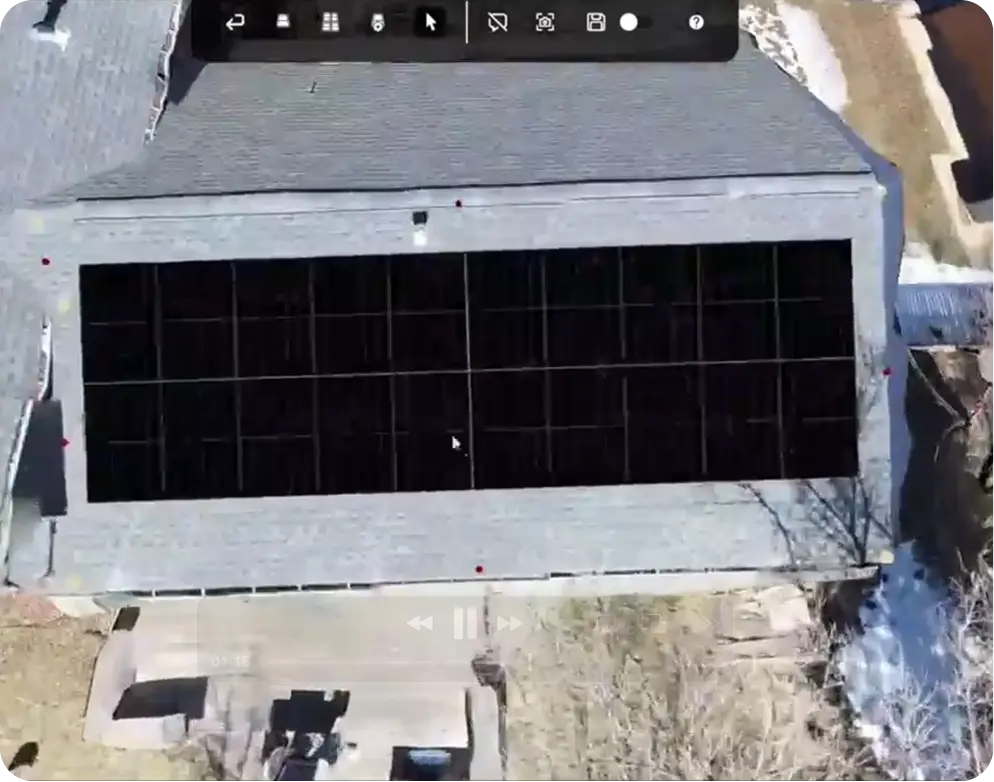
Problems

The Yield Gap: Unquantified Shading & Obstacles
When chimneys, parapets, HVAC units, and nearby trees aren’t precisely modeled, your energy predictions are just guesswork. Without high precision drone roof measurement software, you lose the ability to calculate how shadows shift by hour and season. This “drift” in yield predictions leads to underperforming systems and lost client trust.
The Data Trap: Access Constraints & Compromised Quality
Slippery surfaces, fragile cladding, and steep slopes make critical zones unreachable for manual measurement. You lose accuracy when you’re forced to “estimate” dimensions due to safety constraints. These incomplete data sets lead to quoting delays and approval bottlenecks that slow down your entire pipeline.
The Profit Leak: Inconsistent Notes & Schedule Slips
Relying on paper notes and simple photo-based workflows is a recipe for error. When roof slopes and footprints are recalculated again and again due to inconsistent manual measurements, you lose money on every return trip to the site. These schedule slips push back both your proposals and your installation planning, eating directly into your project margins.
End-to-End Flow: How to Measure Roof with Drone for PV Design ? Modeling and visualization completed within 2 hours
With Render-A’s drone roof survey photogrammetry, you get a seamless workflow from raw data to final PV placement. We don’t just take photos; we ensure the slope and azimuth of every surface are measured with high accuracy. Parapets, chimneys, and other obstacles are tagged in the automatic 3D model, allowing roof slope data to flow directly into your PV layout.
Our 2 hour turnaround includes:
- Universal Compatibility: The result is a bankable energy estimate, bill of materials, and installation plan, exported in one flow. Our outputs are fully compatible with PVsyst, PVSOL, or your preferred solar proposal generator tool.
- Smart Layout: Row spacing, edge safety offsets, and gaps are computed automatically.
- Shading Simulation: Accurate analysis by hour and season to maximize energy output.
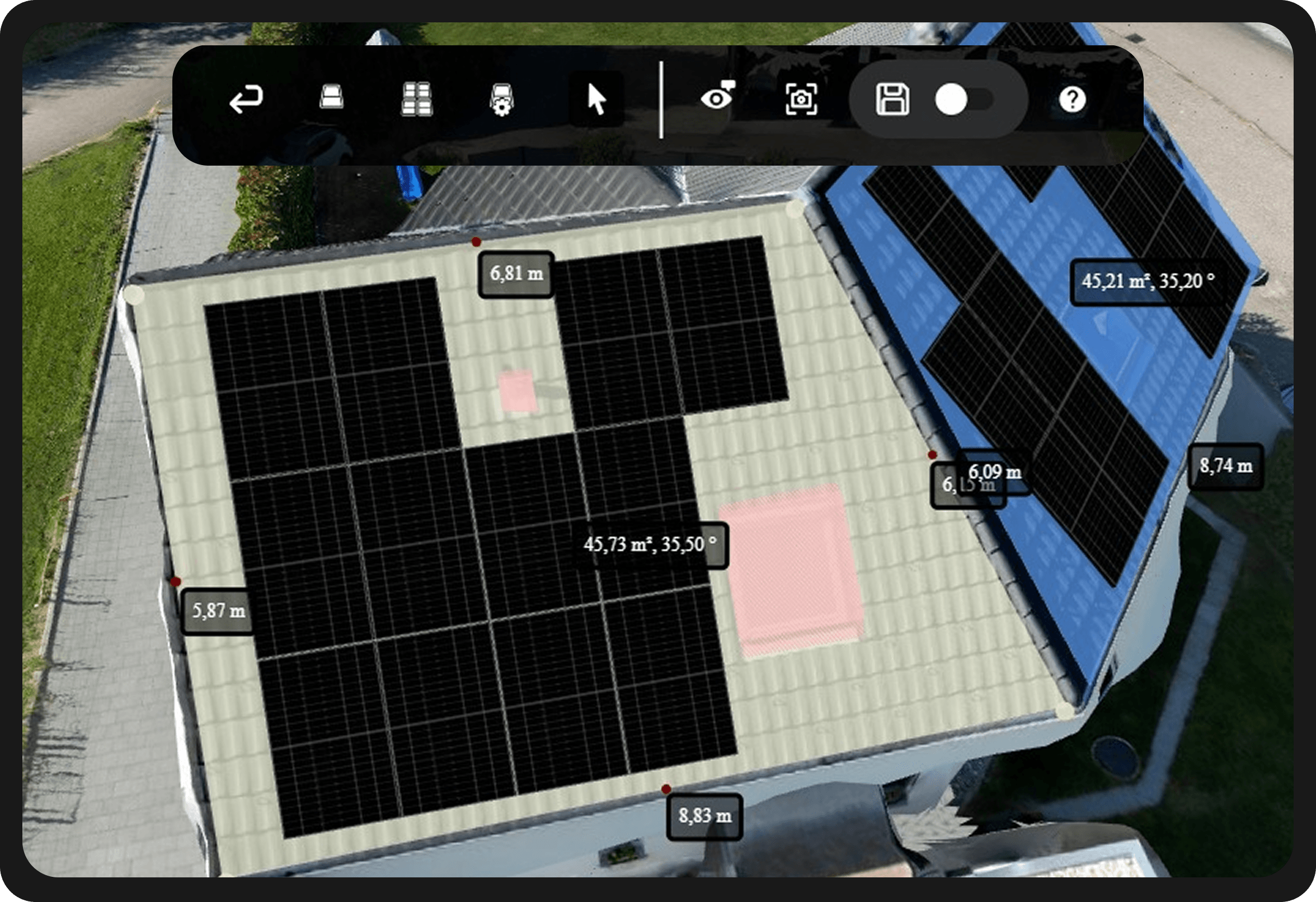

3D digital twin in 2 hours
Drone data is processed with photogrammetry following a comprehensive drone roof survey. Roof slope and obstacles are computed in a single pass and the model is ready within 24 hours.

True to scale, measurable 3D geometry
The mesh derived from orthophoto and point cloud is matched to real scale. Areas, slopes, and edge lengths are measured one to one, so takeoff and layout data becomes reliable.

PV module layout and string predesign
Using surface based roof slope and azimuth, the module grid is generated automatically. Row spacing, edge safety margins, walkways, and equipment offsets are calculated. Time and season dependent shading scenarios are evaluated. Results feed string predesign and array balancing, then transfer to PVsyst and PVSOL projects.
How to Measure Roof with Drone for PV Design?
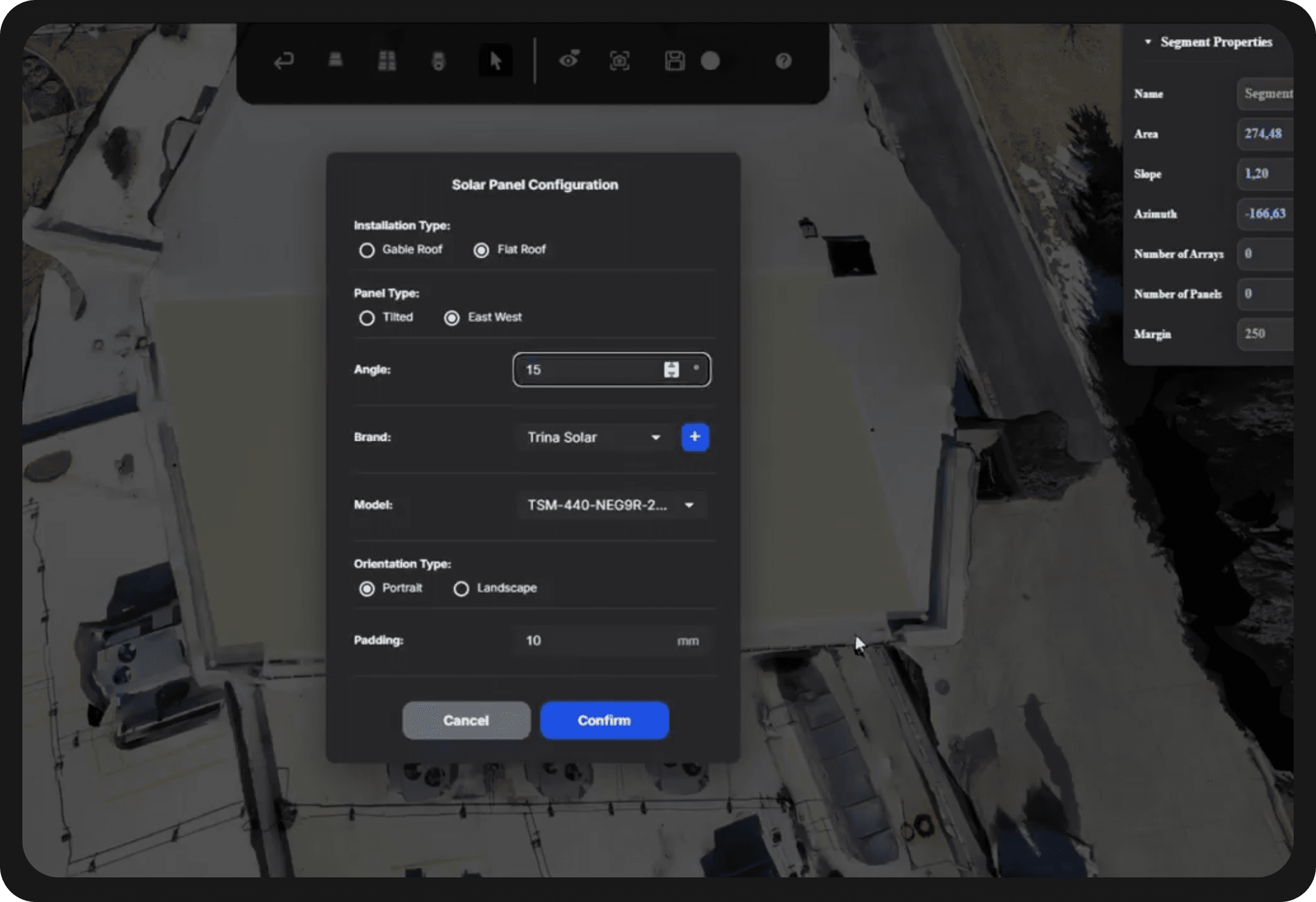
Start by selecting the mounting type. Gable Roof is for pitched roofs. Flat Roof is for level roofs. This choice adjusts substructure rules to the roof slope and geometry.
For pitched roofs the panel type is fixed to the single appropriate mounting. For flat roofs you can choose Tilted or East West. The Angle field appears only for flat roofs and sets the tilt relative to the roof plane. On pitched roofs the panel angle is automatically matched to the true roof slope of that surface.
The module library includes 50 manufacturers and more than 6100 PV modules. Dimensions, frame, clamp zones, and electrical parameters flow directly into layout, string predesign, and quantity takeoff. Orientation Type sets the module direction to Portrait or Landscape and aligns it with the ridge direction. Padding (mm) defines inter panel spacing. Typical values are 500 to 1000 mm on flat roofs for walkways, and 10 to 40 mm on pitched roofs for thermal expansion. Because these values are visible on the plan, edge to edge fitting errors are avoided. For example, a 4 cm gap across 20 modules adds up to 19 x 4 cm of extra length.
F.A.Q
Rendera creates georeferenced 3D roof models that allow precise calculation of slope, azimuth, surface area, and complex geometries. When GPS-enabled drone imagery is used, accuracy is typically within a few centimeters. Non-georeferenced inputs such as phone images are also supported, but they provide only relative measurements without a guaranteed scale.
Yes. The generated models provide a detailed digital twin of the roof that can be used to document conditions, identify repair areas, and prepare material takeoffs. This reduces the need for physical site visits and improves safety for inspection teams.
Rendera is focused on geometric and spatial accuracy. It does not perform structural or thermal simulations, but its exported datasets are compatible with engineering tools that can carry out these analyses.
Rendera supports any aerial platform capable of capturing high-resolution imagery. For engineering-grade outputs, drones equipped with RTK or PPK GPS modules, as well as LiDAR payloads, are recommended.
Yes, the data provided by Rendera contains the essential technical information required for PV system installation:
Roof slope and orientation (azimuth)
Usable area and metrics
Obstacle detection (chimney, parapet, air conditioning units, etc.)
Shading analysis (hourly and seasonal)
3D model and orthophoto
PVsyst/PVSOL compatible outputs
This data is sufficient for installation companies to perform system design, panel placement, inverter selection, and cost calculation. Professional companies like Lion Solar Solutions use these technical documentations to prepare customized quotes and initiate the installation process. This ensures a seamless and reliable process from measurement to installation.
Learning how to measure roof with drone technology is simpler than it sounds. At Render-A, we streamline this process into three steps:
Capture: Fly a standard drone to capture overlapping aerial images.
Process: Upload data to Render-A to generate a 3D mesh.
Design: Instantly export slope, area, and obstacle data to your solar proposal generator tool render-a.