The New Reality of 3D Data Overload
The digital world is awash in data, and nowhere is this more true than in industries relying on three-dimensional reality capture. Drones, LIDAR scanners, and photogrammetry are generating massive 3D data points gigabytes of complex information that must be analyzed to make critical business decisions. Traditionally, converting this dense data into actionable insights has been a labor-intensive, time-consuming process known as 3D measurement.
In an era defined by speed, relying solely on human expertise for tasks like roof damage detection or precise quantity takeoff is a massive bottleneck. This is the challenge Render-a (or the platform) addresses: by embedding AI (Artificial Intelligence) deep into the workflow, we are not only accelerating the process but also redefining the benchmarks for accuracy and scalability in 3D modelling and inspection.
This article delves into how advanced AI models are leveraging 3D data to solve complex, real-world problems from segmentation to classification faster than any human team, ensuring your business stays ahead of the curve.
AI’s Competitive Edge: Speed, Scale, and Accuracy
Why is AI fundamentally changing the game of 3D measurement? The answer lies in three key areas where machines consistently outperform human capabilities:
1. Unmatched Processing Speed and Scale
Manual 3D measurement involves an expert painstakingly clicking points, defining polygons, and calculating volumes. This process, even for a single roof, can take hours. AI, specifically Deep Learning algorithms, can process millions of data points (data) instantly. A single drone flight capturing a large construction site can be analyzed for material quantity takeoff (e.g., roof square footage, lineal meters of gutter) in minutes, not days.
- AI systems use natural language understanding (NLU) to process text prompts (“Find all HVAC units”) and instantly execute complex spatial queries on the 3D model, bridging the gap between human language and volumetric data.
2. Eliminating Human Fatigue and Subjectivity
The accuracy of manual 3D measurement declines exponentially with the size and complexity of the model and the duration of the task. Human eyes get tired, and interpretations can vary. AI offers consistency and objectivity. In tasks like identifying small cracks or displaced roof tiles (damage detection), the AI model applies the same, trained criteria to every single pixel or data point, achieving over 99% detection accuracy without fail. This reliability is vital for the insurance and construction industries, where every dollar counted in 3D measurement matters.
3. Smart Segmentation and Classification
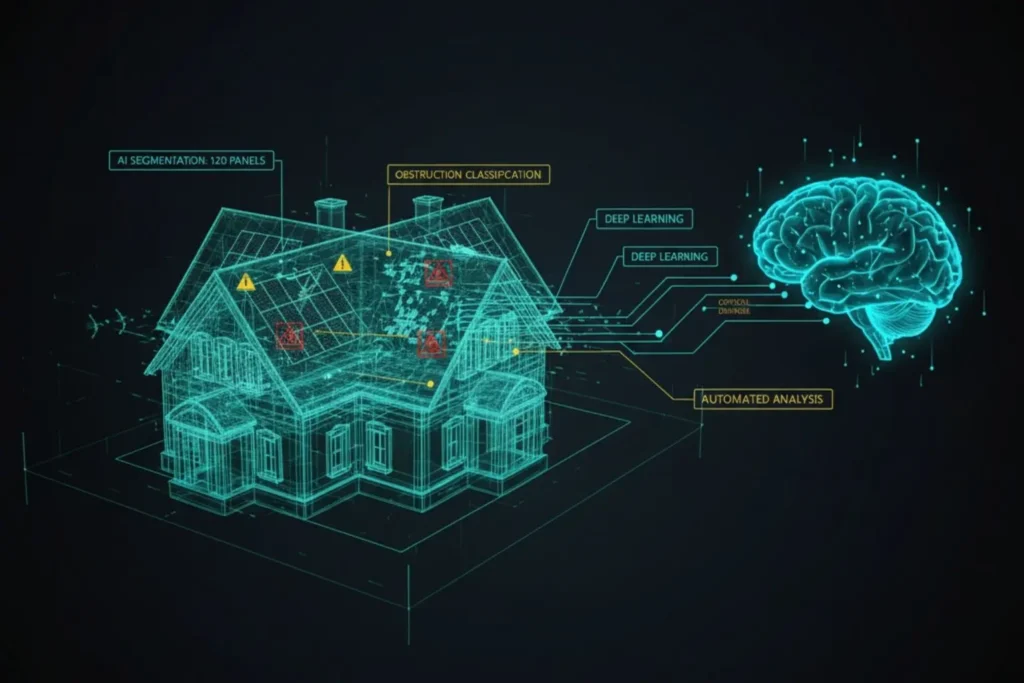
The true power of AI is its ability to automatically understand the contents of a 3D model. This is called segmentation and classification. While a human sees a structure, the AI sees:
- Panels: Automatically isolating every solar panel for health and performance analysis.
- Chimneys and Vents: Precisely delineating all obstructions for optimized placement or 3D modelling purposes.
- Tiles/Shingles: Classifying the type and condition of every roofing material.
This detailed, automated understanding transforms raw data into a structured, searchable database, fundamentally shifting the paradigm of asset management.

Core AI Powered Capabilities and Their Applications
The integration of AI with 3D modelling and reality capture is yielding powerful, commercial applications:
A. Automated Quantity Takeoff and Metrology (3D Measurement)
In the construction sector, calculating accurate material quantities is essential. AI-powered software can directly analyze a point cloud or mesh and extract volumes, areas, and lengths with sub-centimeter precision. This capability directly reduces material waste and drastically cuts down on project time.
B. Predictive Maintenance and Damage Classification
This goes beyond simple detection. AI models can classify the severity and type of damage (e.g., surface crack vs. deep structural fissure, light rust vs. critical corrosion). By analyzing historical 3D data, the AI can project the structural lifetime of an asset, moving businesses from reactive repair to proactive maintenance.
C. Real Time Compliance and Code Checking
Imagine uploading a 3D model and having an AI instantly check local building codes for everything from setback requirements to chimney height regulations. This feature uses AI to compare the as-built 3D measurement against regulatory data standards, preventing costly fines and project delays before they occur.
Deepening the Dive: AI, Data, and The Digital Twin
The future of 3D measurement is inextricably linked to the concept of the Digital Twin. By continuously feeding new data (captured via drone flights, sensors, etc.) into the 3D model, the AI maintains an always-current, highly accurate virtual replica of the real-world asset.
- For those interested in the foundational technology powering this shift, a deeper look into the principles of Neural Radiance Fields (NeRF) offers insight into how AI is creating hyper-realistic 3D models from simple image data (e.g., See how NVIDIA leverages AI for 3D reconstruction).
- This process relies heavily on structured data formats. Look : Render-a
The algorithms that power these twins, often fine-tuned versions of open-source models (like those shared by OpenAI, Google, or Meta), are the keys to unlocking complex 3D measurement insights that were previously impossible.
Transform Your Data into Decision Making Power
The era of slow, manual 3D measurement is drawing to a close. AI is accelerating our ability to process complex 3D data, turning visual information into objective, actionable intelligence. From automatically classifying every component of a roof to generating precise quantity takeoffs, the convergence of 3D modelling and cutting-edge AI represents the most significant leap in efficiency the construction and inspection sectors have ever seen.
Are you ready to stop measuring and start mastering your assets?
Don’t wait for the future of inspection; build it today with Render-a.
Visit the Render-a YouTube Channel: Watch our latest AI-powered 3D measurement demos and expert interviews. Render-a Youtube
Follow Render-a on LinkedIn: Get first-hand updates on the future of the industry and 3D modelling innovations.