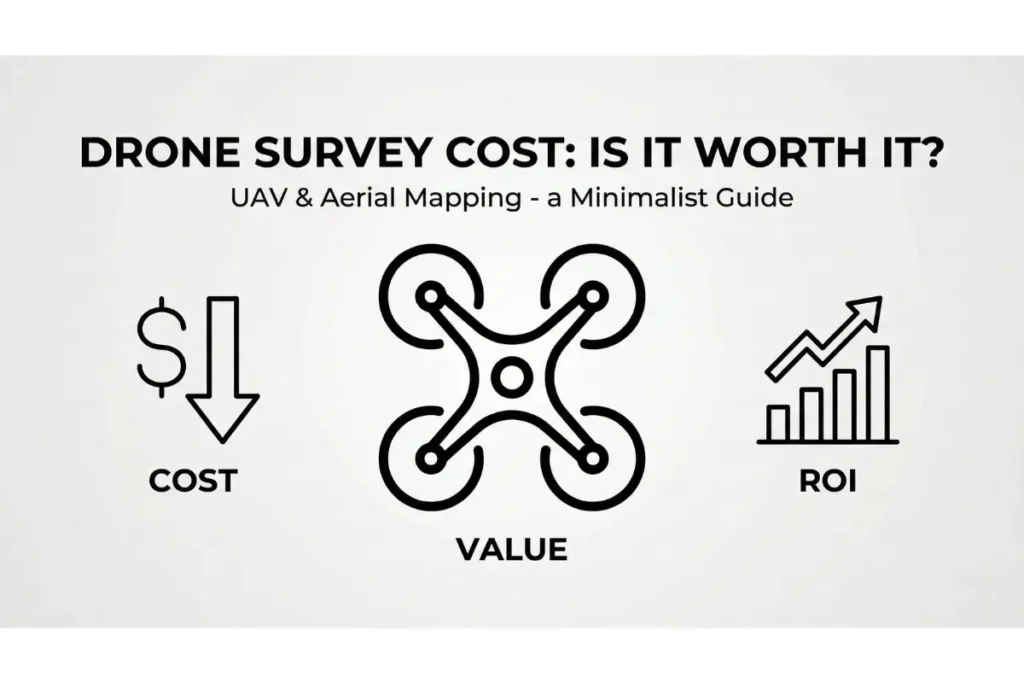
“The best investment is one that saves you money while improving your results. Drone technology has fundamentally changed how we approach surveying and mapping projects.” This reality has transformed industries ranging from construction to agriculture. Understanding drone survey cost and whether aerial survey technology justifies the expense requires examining multiple factors, from equipment specifications to project requirements.
Understanding Drone Survey Cost in Today’s Market
Drone survey cost varies considerably based on project complexity, location, and the level of detail required. When discussing UAV mapping expenses, professionals must consider that pricing reflects more than just flight time. The cost encompasses equipment depreciation, pilot training, software licensing, data processing, and quality assurance measures that ensure accurate results.
Current market rates for drone survey services range between $500 and $5,000 for standard residential projects, while larger commercial operations can exceed $10,000. Agricultural surveys might cost $800 to $2,000 per project depending on acreage, whereas industrial site inspections often run higher due to safety requirements and specialized equipment needs.
The drone survey cost you’ll encounter depends heavily on whether you’re hiring a professional surveying company or purchasing your own equipment. For businesses conducting frequent surveys, ownership might reduce per project expenses within 12 to 24 months. However, initial capital investment, ongoing maintenance, software subscriptions, and regulatory compliance create substantial upfront obligations.
What Factors Influence UAV Mapping Pricing
Several key elements determine the final drone survey cost for your specific project:
- Project size and total acreage to be surveyed
- Terrain difficulty and accessibility constraints
- Required ground sampling distance and image resolution
- Weather conditions and seasonal considerations
- Deliverable requirements and processing complexity
- Regulatory compliance and airspace restrictions
- Equipment specifications and technological capabilities
- Data processing and software analysis needed
Professionals conducting aerial survey work understand that a small parcel of flat, accessible land costs considerably less than surveying mountainous terrain or properties with significant obstructions. The drone survey cost increases substantially when clients need high-resolution orthomosaics, 3D point clouds, or digital elevation models that require advanced processing.
Comparing Drone Survey Cost to Traditional Surveying Methods
Traditional land surveying methods rely on ground crews, multiple vehicles, and extensive on site time. These approaches typically cost $1,500 to $10,000 or more, depend on property size and complexity. The labor intensive nature of conventional surveying, combined with equipment wear and extended project timelines, often makes these methods less economical than modern UAV mapping alternatives.
Aerial survey technology using drones completes projects in a fraction of the time. A property that required three days of traditional surveying might be mapped via drone in just a few hours. This efficiency directly translates to lower overall drone survey cost despite potentially higher hourly rates. Additionally, UAV mapping provides superior data density, capturing millions of data points that would be impossible or prohibitively expensive to collect manually.
When evaluating total cost of ownership, aerial survey methods demonstrate clear advantages. Reduced labor requirements, faster turnaround times, minimized safety risks, and superior data accuracy collectively make drone survey cost investments highly attractive for long term business operations.
Breaking Down the Components of UAV Mapping Expenses
Understanding where your drone survey cost goes helps you make informed decisions about value. Equipment represents a significant component, with professional grade UAVs ranging from $3,000 to $50,000 depending on specifications. A mid range survey drone with high quality cameras and GPS accuracy might cost $15,000 to $30,000.
Beyond equipment, drone survey cost includes several operational expenses:
- Software licenses for flight planning and data processing applications
- Pilot training and Part 107 certification requirements
- Insurance and liability coverage for drone operations
- Maintenance, repairs, and battery replacement cycles
- Data storage and cloud processing services
- Quality assurance and result verification
- Regulatory compliance and permit acquisition
Professional surveying companies factor these ongoing costs into project pricing. When you hire an external provider for your aerial survey needs, you benefit from their amortized equipment investment, experienced pilots, and optimized workflows. This arrangement often proves more economical than attempting to manage drone operations internally without existing expertise.
Is the Investment in UAV Mapping Worth It?
Return on investment for drone survey cost depends on your industry, project frequency, and operational needs. Construction companies managing multiple sites per year quickly recover initial investments through improved project coordination and reduced rework costs. Real estate professionals gain competitive advantages by offering premium property documentation that attracts buyers and justifies higher asking prices.
Aerial survey capabilities enable better decision making across numerous applications. Mining operations use drone data to optimize excavation planning. Agricultural businesses apply UAV mapping results to precision farming strategies. Insurance companies expedite claims processing through aerial documentation. Each application delivers measurable value that exceeds the drone survey cost investment.
For property managers overseeing large commercial portfolios, regular aerial surveys provide documented baselines for asset condition assessment. This proactive approach prevents costly surprises, facilitates maintenance planning, and supports property valuations. The relatively modest drone survey cost compared to potential damage prevention creates compelling financial justification.
Time savings alone often justify investing in UAV mapping. Projects completed in days rather than weeks reduce holding costs, enable faster market entry, and improve team productivity. When you calculate the cost of keeping crews on site or delaying project milestones, aerial survey expenses become quite reasonable.
Professional Drone Survey Services vs. DIY Approach
Some organizations consider purchasing equipment and training staff to conduct their own drone survey operations. This approach involves significant upfront drone survey cost but potentially reduces per project expenses for high volume operators. However, several factors complicate the DIY strategy.
Regulatory compliance requires Part 107 certification for commercial operations, demanding both study time and examination fees. Equipment maintenance and technology updates create ongoing expenses. Software training for flight planning and data processing requires dedicated resources. Insurance requirements for commercial drone operations add annual costs. Most critically, liability concerns arise if operations cause property damage or personal injury.
Experienced surveying companies provide liability protection through comprehensive insurance coverage. Their pilots possess current certifications and specialized training in surveying applications. Their software and equipment receive regular updates ensuring compliance with evolving regulations. When comparing total drone survey cost to the risks and hidden expenses of internal operations, external service providers often provide superior value.
How Render-A Approaches Drone Survey Solutions
Specialized providers like Render-A combine drone survey capabilities with advanced 3D modeling and data processing services. This integrated approach transforms raw aerial data into actionable intelligence. Rather than delivering basic orthomosaics, comprehensive service providers create detailed 3D models, volumetric analyses, and strategic insights that guide project decisions.
Professional UAV mapping through specialized firms eliminates guesswork about deliverable quality. You receive precisely what projects require, whether that involves high resolution orthophotos, point cloud data, digital surface models, or integrated 3D documentation. This alignment between deliverables and needs ensures that drone survey cost delivers genuine project value.
Learn more about professional land surveying solutions at Render-A’s 3D land surveying services to understand how integrated approaches optimize survey efficiency and data quality.
Emerging Trends Affecting Drone Survey Pricing
Technology advancement continues reshaping aerial survey market dynamics. Newer drone models offer improved cameras, longer flight times, and better payload capacity, gradually reducing survey times and improving data quality. Software automation increasingly handles routine processing tasks, reducing labor intensive data analysis work.
Regulatory evolution affects drone survey cost through both restrictions and opportunities. As drone regulations mature and safety frameworks solidify, insurance costs stabilize while operational predictability improves. New approved use cases continually emerge, expanding markets for aerial survey services.
Integration with complementary technologies like AI and machine learning adds capabilities previously impossible. Automated feature detection and classification extract more meaning from survey data. These advancements increase service provider value, potentially justifying modest price increases compared to outdated approaches.
Competition among providers drives drone survey cost down while service quality improves. As market maturity increases and more companies enter the aerial survey space, differentiation occurs through specialized capabilities, superior customer service, and integrated solutions rather than price alone.
Practical Guidance for Evaluating Drone Survey Proposals
When requesting drone survey cost estimates, provide detailed project specifications to receive accurate proposals. Include information about total area, terrain characteristics, required accuracy levels, desired deliverables, and timeline constraints. Vague requests generate similarly vague quotes that fail to reflect actual project costs.
Compare proposals not just on drone survey cost but on included services. Does pricing encompass data processing? Are quality assurance measures included? Will you receive consultation on interpreting results? Some providers charge lower base fees but add hidden charges for analysis, processing, or revision rounds. Comprehensive proposals itemizing all services simplify comparison.
Verify that proposed providers maintain appropriate insurance, hold current certifications, and understand your specific industry requirements. A survey company experienced with your particular application provides better service than generalist providers applying generic approaches.
Consider long term relationships rather than single projects. Service providers who understand your organization’s standards, preferences, and technical requirements become increasingly valuable over time, potentially offering volume discounts as relationship depth grows.
Frequently Asked Questions About Drone Survey Cost
What is the average drone survey cost for a small residential property?
Small residential properties typically cost between $500 and $1,500 for basic aerial survey work. The drone survey cost depends on property size, terrain accessibility, and required image resolution. Simple orthomosaics cost less than comprehensive 3D models requiring extensive data processing.
How does UAV mapping pricing compare to traditional surveying?
Traditional surveying often costs more than UAV mapping for comparable results. Drone survey cost typically runs 40 to 60 percent lower than conventional methods when project timelines and accuracy are equivalent. The significant labor reduction through aerial survey methods creates the cost advantage.
What factors most significantly impact aerial survey costs?
Project size and terrain difficulty represent the primary cost drivers. Larger areas require longer flight times. Difficult terrain or vegetation obstructions necessitate multiple flight passes or specialized equipment. Required accuracy levels and deliverable complexity also substantially influence drone survey cost.
Can I purchase a drone and conduct surveys myself to avoid ongoing service costs?
Equipment ownership is possible but involves significant expenses beyond the drone purchase. Pilot certification, insurance, software licenses, maintenance, and data processing training create substantial hidden costs. For occasional survey needs, external service providers typically offer better value than internal operations.
How accurate is aerial survey data from drones?
Modern drone survey data achieves accuracy within 2 to 5 centimeters under optimal conditions, meeting or exceeding traditional surveying precision. Ground control points can further improve accuracy to sub centimeter levels when required for specialized applications. The drone survey cost for high accuracy work may increase moderately.
What industries benefit most from UAV mapping investments?
Construction, real estate, agriculture, mining, and infrastructure management realize the greatest benefits from UAV mapping. These industries conduct frequent surveys where efficiency gains and superior data justify drone survey cost. Environmental monitoring, insurance claims, and archaeological applications also leverage aerial survey capabilities effectively.
Making Your Drone Survey Investment Decision
Drone survey cost represents a legitimate business investment rather than an discretionary expense when you understand how aerial survey data drives project success. The market offers clear evidence that UAV mapping delivers superior efficiency, cost effectiveness, and data quality compared to traditional approaches. Whether you operate as a construction company, real estate firm, agricultural business, or government agency, aerial survey capabilities provide competitive advantages worth pursuing.
The key to successful adoption involves selecting the right service provider and clearly defining project requirements before requesting proposals. Professional companies like Render-A bring specialized expertise that transforms basic drone footage into strategic assets. Rather than focusing solely on minimizing drone survey cost, emphasize maximizing the value received from every dollar invested.
As technology continues advancing and market maturity increases, the question shifts from whether UAV mapping is worth the investment to how quickly you can implement these capabilities to improve operations. The organizations achieving greatest success recognize that aerial survey technology represents not a cost but an investment in superior decision making, accelerated timelines, and enhanced competitive positioning.
For comprehensive aerial surveying and 3D mapping solutions, explore the specialized services provided by industry leaders. Connect with Render-A on LinkedIn to stay current with the latest surveying technologies and methodologies. Visit their YouTube channel for detailed demonstrations of drone survey capabilities and data processing techniques.