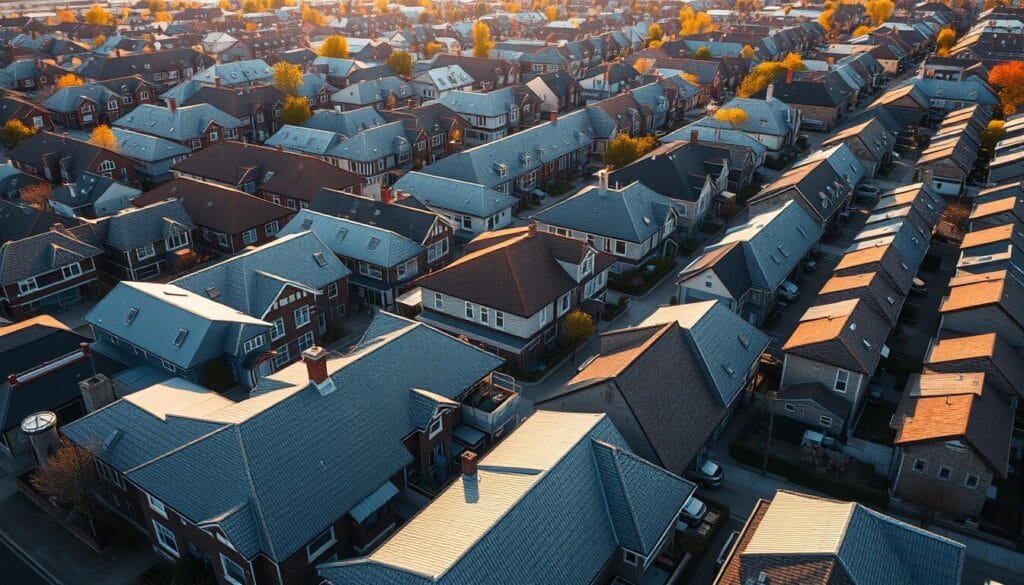
The drone technology revolution has transformed the field of roof surveying, bringing unprecedented accuracy and efficiency. The choice between high-resolution photogrammetry solutions, often enhanced with RTK/PPK, and the superior absolute accuracy of specialized LiDAR technology is a significant dilemma for surveyors.
Surveyors face a critical question: Is the widely accessible, high-resolution photogrammetry solution enough for your needs? Or does the superior absolute accuracy of LiDAR justify the significant investment? This article serves as your definitive guide, cutting through the technical jargon. It provides an expert framework for making informed decisions.
Key Takeaways
- Understanding the core differences between photogrammetry and LiDAR for roof surveys.
- Evaluating the accuracy and cost trade-offs of RTK/PPK photogrammetry and LiDAR.
- Identifying the most suitable technology for specific surveying needs.
- Gaining insights into the latest advancements in drone mapping and aerial surveying.
- Applying an expert framework to make informed decisions on surveying technology investments.
The Evolution of Aerial Roof Survey Technologies
Advances in aerial survey tech have transformed roof inspections and mapping. The use of drone photogrammetry and LiDAR has greatly improved survey accuracy and speed. These technologies have become essential for detailed roof assessments.
Current Challenges in Roof Mapping and Inspection
Despite these advancements, challenges persist in roof mapping and inspection. Traditional methods are slow and error-prone, involving manual data collection. Accessing some roof areas is also risky for inspectors. This has led to the adoption of aerial survey technologies for more accurate and reliable data.
The Fundamental Difference Between Photogrammetry and LiDAR
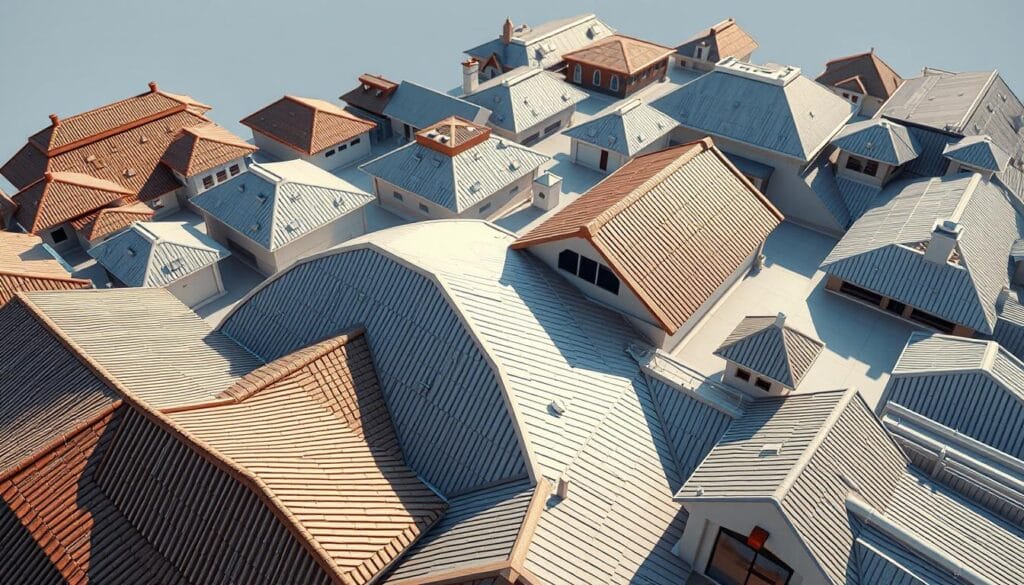
Photogrammetry and LiDAR are two unique technologies in aerial roof surveys. Photogrammetry creates 3D models from images, while LiDAR generates point cloud data with laser pulses. Knowing the differences between these is key to choosing the right method for a project.
Why Accuracy and Cost Matter for Roof Surveys
Accuracy and cost are vital in roof surveys. High accuracy is needed for dependable digital elevation models and 3D models. Cost considerations, on the other hand, affect project feasibility. Finding a balance between these factors is critical for successful roof surveys.
The choice between photogrammetry and LiDAR depends on project needs, budget, and roof complexity. Each technology has its strengths, making the right choice essential for effective surveys.
Drone Photogrammetry Explained: Core Technology and Workflow
Drone photogrammetry, enhanced by RTK/PPK technology, offers unmatched precision in aerial data capture. This advanced method involves taking multiple images from various angles. These images are then processed to create detailed 3D models and maps.
How RTK/PPK Drone Photogrammetry Works
RTK/PPK technology boosts the accuracy of drone photogrammetry by providing precise location data. It ensures centimeter-level accuracy, making it perfect for tasks needing high precision, like roof surveys.
Equipment Requirements and Setup Process
To perform drone photogrammetry, you need a drone with a high-resolution camera, RTK/PPK module, and a gimbal for stabilization. The setup involves planning the drone’s flight path, adjusting camera settings, and ensuring the RTK/PPK system is ready.
| Equipment | Description | Importance |
|---|---|---|
| Drone | High-resolution camera and RTK/PPK module | High |
| Gimbal | Stabilization for camera | Medium |
| Software | Photogrammetry processing software | High |
Data Collection and Processing Methodology
Flying the drone over the area of interest and capturing images with enough overlap is the data collection phase. The processing involves aligning these images, creating a point cloud, and generating a 3D model or orthomosaic.
Image Overlap Considerations
Ensuring adequate image overlap is key for accurate photogrammetry. A 60% to 80% overlap is generally recommended to allow the software to correctly align the images.
Flight Altitude Effects on Resolution
The resolution of the images captured is directly influenced by the flight altitude. Lower altitudes yield higher resolution but require more images to cover the same area.
LiDAR Technology: Working Principles and Implementation
LiDAR technology has transformed aerial surveying by delivering precise data. This section explores LiDAR’s working principles and its integration into drone systems.
How Drone LiDAR Systems Capture Data
Drone LiDAR systems emit laser pulses towards the ground. They measure the time-of-flight of the reflected pulses. This method creates a detailed 3D model of the surveyed area.
Required Hardware Components and Integration
Drone LiDAR systems need a LiDAR sensor, GPS, and IMU. These components ensure accurate positioning and orientation. This is vital for precise data capture.
Data Acquisition and Processing Workflow
The data acquisition process involves flying the drone over the survey area. It captures LiDAR data during this time. The data is then processed using specialized software to generate a point cloud.
Point Cloud Generation
Generating a point cloud is a key step in LiDAR data processing. It creates a 3D representation of the surveyed area using the captured LiDAR data.
Classification and Filtering Techniques
Classification and filtering techniques are used to categorize the point cloud data. This includes separating data into ground, vegetation, and buildings. This step is essential for accurate data analysis and interpretation.
Accuracy Metrics: Defining What Matters for Roof Surveys
To assess roof survey technologies, one must first understand the various aspects of accuracy. Roof survey accuracy is not a single dimension. It includes several metrics, each critical for different roofing applications.
Absolute vs. Relative Accuracy: Critical Distinctions
Absolute accuracy measures how close a measurement is to the true value. Relative accuracy, on the other hand, focuses on the precision of measurements relative to each other. Both are essential for roof surveys but serve distinct purposes.
Absolute accuracy is key for ensuring survey data matches real-world coordinates, vital for GIS integration. Relative accuracy, by contrast, ensures data consistency, critical for detailed roof modeling and analysis.
Vertical Accuracy Requirements for Different Roof Types
Vertical accuracy needs vary by roof type. For example, complex roofs with multiple slopes require higher vertical accuracy to accurately capture their details.
| Roof Type | Vertical Accuracy Requirement |
|---|---|
| Simple Flat Roofs | 5-10 cm |
| Complex Multi-Slope Roofs | 2-5 cm |
| Industrial Roofs with Equipment | 1-3 cm |
Point Cloud Density and Resolution Considerations
Point cloud density and resolution are key for capturing detailed roof survey data. Higher density and resolution lead to more detailed models. These are vital for tasks like roofing material estimation and structural analysis.
Visual Fidelity and Texture Mapping Importance
Visual fidelity and texture mapping improve roof survey data interpretation. They make it easier to identify features and materials. This is critical for tasks requiring high detail, such as roofing condition assessment.
Measurement Precision for Specific Roofing Applications
Different roofing applications demand varying precision levels. For instance, estimating roofing material quantity requires less precision than detailed structural analysis or condition assessment.
Grasping these accuracy metrics and their implications is vital for choosing the right roof survey technology. It ensures the collected data meets project-specific needs.
Comprehensive Cost Analysis of Both Technologies
Choosing between Drone Photogrammetry and LiDAR for roof surveys requires a detailed cost analysis. This includes the total cost of ownership and operation for each technology. Understanding these financial implications is key to making an informed decision.
Hardware Acquisition and Maintenance Expenses
The initial hardware investment is a major factor in costs. Drone Photogrammetry systems need high-resolution cameras and RTK/PPK GNSS modules. LiDAR systems, on the other hand, require expensive LiDAR sensors and often more robust drones to handle the weight.
Maintenance costs differ between the two. LiDAR systems, with their complex sensors, tend to have higher maintenance expenses than photogrammetry camera systems.
Software Licensing and Processing Costs
Software costs are a significant part of the overall expense. Photogrammetry software, such as Agisoft Metashape or Pix4D, can cost from a few hundred to several thousand dollars. This depends on the license type and required features.
LiDAR data processing software, like TerraSolid or Leica Cyclone, also comes with a price tag. Prices vary based on software complexity and the number of users.
Operational, Training, and Field Time Expenses
Operational costs, including training and field time, are substantial. LiDAR systems often require specialized training due to their complexity.
Field time expenses, such as drone pilots, support staff, and equipment transportation, can vary. This depends on the project’s location and scale.
Long-term ROI Calculations for Different Project Scales
Calculating the return on investment (ROI) for Drone Photogrammetry and LiDAR is critical. It’s essential to consider the project scale and frequency. For large or frequent projects, LiDAR’s high initial cost may be justified by its accuracy in challenging environments.
For smaller or less complex projects, Drone Photogrammetry might be more cost-effective. It offers acceptable accuracy levels at a lower cost.
By evaluating these cost factors, organizations can make informed decisions. This ensures optimal ROI for their roofing projects, aligning with their needs and budget.
Photogrammetry Strengths and Limitations for Roof Mapping
Photogrammetry in roof surveys shows both benefits and drawbacks. It captures detailed visual data, making it ideal for specific roof mapping tasks.
Superior Visual Fidelity for Simple and Textured Roofs
Photogrammetry stands out for its high visual fidelity, perfect for simple and textured roofs. It’s ideal when detailed visuals are essential.
Excellent Relative Accuracy Performance
It also boasts excellent relative accuracy, ideal for precise roof feature measurements. This is key for solar panel layout, where exact placement is vital.
Challenges with Reflective Roofing Materials
Yet, photogrammetry faces hurdles with reflective roofing materials. These can distort data capture, leading to model inaccuracies.
Limitations in Low-Texture and Complex Roof Environments
It also falters in low-texture and complex roof environments. Here, it may miss critical details, affecting accuracy.
Case Studies: Solar Panel Layout and Simple Pitch Roofs
Case studies highlight photogrammetry’s success in solar panel layout and simple pitch roofs. For example, a large commercial roof mapping for solar panels benefited from its detailed visuals and accuracy.
In summary, photogrammetry is a strong tool for certain roof mapping tasks due to its visual fidelity and relative accuracy. Yet, its limitations, like issues with reflective materials and complex roofs, must be acknowledged.
LiDAR Advantages and Constraints in Roofing Applications
LiDAR technology has become essential in roofing due to its unparalleled accuracy and vertical precision. It stands as a key player in the industry, addressing complex roofing needs with its array of benefits.
Unmatched Absolute and Vertical Accuracy Benefits
LiDAR’s high-precision data delivery is a major advantage. It achieves this through laser pulses emitted and reflected back, providing accurate distance measurements. This leads to:
- Highly accurate point clouds that represent the roof surface with precision.
- Vertical accuracy that is critical for assessing roof conditions, even in complex structures.
Material Independence for Diverse Roof Types
LiDAR’s performance is not impacted by roofing material type, unlike photogrammetry. It can survey roofs with various materials, from metallic to asphalt shingles, maintaining accuracy. This versatility makes LiDAR a valuable tool for diverse roofing applications.
Canopy Penetration for Obscured Structures
LiDAR’s ability to penetrate canopy and vegetation is a standout feature. It is ideal for surveying roofs in densely vegetated areas or where structures are obscured. This ensures data collection is not affected by environmental factors.
Digital Terrain Model (DTM) Generation Capabilities
LiDAR data can generate accurate Digital Terrain Models (DTMs). These models are essential for understanding the topography around the roof. They are invaluable for large-scale projects or areas with complex terrain.
Case Studies: Complex Commercial Roofs and Vegetation-Heavy Sites
Case studies demonstrate LiDAR’s effectiveness in roofing applications. For example, a complex commercial roof with multiple levels and obscured areas was surveyed accurately using LiDAR. In vegetation-heavy sites, LiDAR’s canopy penetration allowed for the accurate mapping of roofs that were previously difficult to survey.
In conclusion, LiDAR offers significant advantages in roofing applications, including absolute accuracy, material independence, canopy penetration, and DTM generation. While it has constraints, its benefits make it a valuable asset in the industry.
Step-by-Step Decision Framework: Choosing the Right Technology
The decision between Drone Photogrammetry and LiDAR for roof surveys hinges on several critical factors. These include project requirements, budget, and the roof’s complexity. Each plays a significant role in the choice.
Defining Your Project’s Accuracy Requirements
It’s essential to understand the accuracy level needed for your project. The complexity and intended use of the data collected dictate the requirements. Different roofing projects have unique needs.
Assessing Budget Constraints and ROI Expectations
Budget is a key factor in selecting technology. Evaluating the return on investment (ROI) for each option is vital. This ensures a cost-effective choice.
| Factor | Drone Photogrammetry | LiDAR |
|---|---|---|
| Accuracy | High relative accuracy | High absolute accuracy |
| Cost | Generally lower | Generally higher |
| Complexity | Suitable for simple roofs | Suitable for complex roofs |
Evaluating Site-Specific Challenges
Site-specific challenges, like roof material and environmental conditions, impact technology choice. These factors are critical to consider.
Matching Technology to Deliverable Requirements
The last step is to align the chosen technology with project deliverables. This ensures the selected method meets all necessary specifications.
Decision Flowchart for Common Roof Survey Scenarios
Use the decision flowchart to visualize the step-by-step process for common roof survey scenarios. It aids in making an informed choice.
Conclusion: Balancing Accuracy Needs with Budget Reality
When deciding between Drone Photogrammetry and LiDAR for roof surveys, finding a balance is key. This balance must consider both the accuracy needed and the budget available. The choice between these technologies hinges on your project’s specific needs, including the level of detail required and your budget.
Drone Photogrammetry excels in providing superior visual fidelity and excellent relative accuracy. It’s perfect for projects needing detailed texture and visual information. In contrast, LiDAR offers unmatched absolute and vertical accuracy. This makes it ideal for applications where precision is critical.
Consider project scale, roof complexity, and accuracy needs when making your decision. For more guidance and visual tutorials, visit the Renderana YouTube Channel. There, you can explore data comparison demos and gain insights into optimizing your roof survey workflow.
By carefully weighing the trade-offs between accuracy and budget, you can choose the best technology for your project. Whether you opt for Drone Photogrammetry or LiDAR, Render-a is ready to support you with the tools and expertise needed for success.
Linkedin: Render-a