Designing commercial and industrial solar arrays has traditionally been a slow, fragmented process. Engineering teams often find themselves trapped in a frustrating cycle of disjointed software. You capture site information with one tool, process the raw drone data in another, wait hours or days for a usable model, and then manually transfer those files into separate drafting and performance simulation programs.
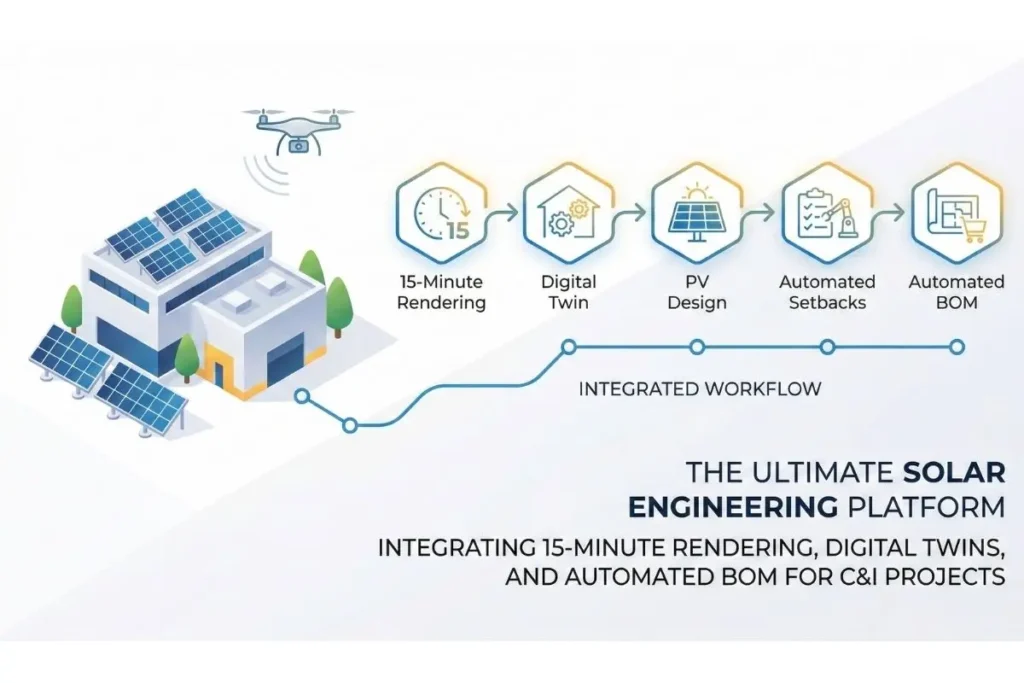
Every time data moves between these disconnected silos, you lose time and increase the margin for error. Finding a true solar engineering platform drone photogrammetry 15-minute rendering digital twin PV design automated setbacks BOM workflow is the definitive goal for modern engineering firms looking to scale. By consolidating these steps into a single, cohesive environment, teams can eliminate bottlenecks and focus on what actually matters: designing highly efficient industrial PV projects.
The Problem with Fragmented Solar Design Workflows
In a standard workflow, the gap between field collection and final design is massive. Surveyors head to the site to collect drone data, which is then uploaded to an independent photogrammetry platform. Depending on the server load and the size of the project, rendering this data into a point cloud or mesh can take anywhere from several hours to a full weekend.
Once the raw model is finally ready, it has to be exported and brought into a 3D modeling software. Here, designers spend hours tracing roof planes, marking obstacles, and manually drawing keep-out zones. After the drafting phase, the layout is moved again into performance software like PVsyst, and then back into CAD for final plan sets. Constructing an accurate Bill of Materials (BOM) requires yet another manual tally of modules, inverters, racking, and wiring. This fractured approach drains resources and significantly delays project turnaround times.
Transitioning to an All-in-One Photogrammetry Platform
The solution to this operational drag is centralizing the entire workflow. Advanced cloud-processing architectures have revolutionized how we handle spatial data, bringing rendering times down from days to mere minutes.
When you upload high-resolution drone measurement sets into a modern, unified system, parallel cloud computing instantly begins stitching the images. Instead of relying on local hardware constraints, the platform leverages enterprise-grade servers to process the photogrammetry and generate a highly accurate, measurable model in about 15 minutes. This rapid turnaround means your design team can begin working on the site layout on the exact same day the site visit occurs, completely transforming project timelines.
The Power of the Digital Twin in Solar Engineering
At the core of this unified approach is the digital twin. A digital twin is not just a static visual representation of a building; it is a data-rich, mathematically accurate, interactive 3D replica of the physical site.
When conducting a comprehensive drone roof survey for a commercial facility, the resulting digital twin captures exact roof pitches, parapet heights, HVAC unit dimensions, and complex shading environments. Because the digital twin understands the physical geometry and spatial relationships of the site, it acts as the single source of truth for the entire engineering lifecycle.
This level of detail is also crucial beyond just the roof. For complex commercial structures, incorporating precise facade measurement ensures that wall-mounted equipment or shading from adjacent architectural features is perfectly accounted for. Similarly, for ground-mounted industrial PV projects, generating a digital twin through accurate 3d land surveying provides the exact topographic data needed to calculate grading, pile lengths, and optimal row spacing without stepping foot back on the site.
Automating Setbacks and Engineering Constraints
Because the digital twin possesses true spatial awareness, the platform can automate the most tedious parts of 3D modeling and compliance. Instead of a designer manually interpreting fire codes and drawing offsets around every single roof obstruction, the platform handles it algorithmically.
You simply input the local jurisdiction’s rules, such as a three-foot perimeter clear zone or specific distances from HVAC units. The software automatically scans the digital twin, identifies the obstacles, and instantly generates the required setbacks and fire lanes. This automated approach completely eliminates the risk of human error during the drafting phase. It ensures that the space available for module placement is 100 percent accurate and compliant with local regulations before you even place the first solar panel.
Seamless PV Design and Automated BOM Generation
Once the workable area is defined, the actual PV design happens directly within the same digital twin environment. You configure your module types, racking systems, and tilt angles, and the software automatically populates the available space, intelligently avoiding the previously established setbacks.
As you build and modify the layout, the platform is working in the background. Because every component placed in the 3D space is tied to a database, the system generates an automated BOM in real-time. Every single solar module, rail, optimizer, roof attachment, and inverter is counted and categorized instantly. If you change a stringing configuration or remove a row of panels to accommodate a new walkway, the BOM updates itself immediately.
Closing the Loop: PVsyst and AutoCAD Integration
An elite platform recognizes that while it handles the heavy lifting, final deliverable formats are still industry standardized. After the layout is optimized and the automated BOM is secured, the platform allows for seamless, one-click exports.
The exact shading scene and layout from the digital twin can be exported directly into PVsyst to generate bankable energy production reports without needing to rebuild the 3D scene. Likewise, the 2D layout, complete with stringing diagrams, setbacks, and dimensions, can be exported as a clean DXF file directly into AutoCAD for the engineering team to finalize the permit packages.
This level of integration accelerates the entire pipeline, significantly improving the efficiency of your solar proposal preparation. By replacing a dozen overlapping software subscriptions with one centralized environment, engineering teams can handle a larger volume of industrial PV projects, reduce overhead costs, and deliver flawless designs to their clients faster than ever before.
Ready to scale your commercial solar operations and leave fragmented software behind? Connect with our team to stay up to date with the latest advancements in digital twin technology, 3D modeling, and automated PV design.
Join our professional network and follow our industry updates through the Lion Solar Solutions LinkedIn page. For detailed software walkthroughs, workflow breakdowns, and visual case studies of our engineering platform in action, be sure to subscribe to the Render-a YouTube channel.