

For most of the solar industry’s history, site surveys have focused on one surface: the roof. Drone-based 3D modelling tools, including Render-a, were built to solve rooftop challenges. Accurate pitch measurements, obstacle mapping, shading analysis, and panel layout optimisation on sloped or flat roof surfaces.
But the market is shifting. Across Europe, compact solar systems are being installed on surfaces that have nothing to do with the roof: balcony railings, garden fences, building facades, shed walls, and ground-mounted frames in communal outdoor spaces. In Germany alone, over one million households have installed plug-in solar systems, the majority on balconies and vertical surfaces rather than rooftops.
The UK is now following. In March 2026, the UK government confirmed that plug-in solar systems of up to 800W will be made legal for domestic use, with updated regulations expected to take full effect by summer 2026. This opens a market of millions of households, particularly in flats and urban terraced housing, where rooftop solar has never been practical.
For solar professionals, this shift creates a new survey requirement. Vertical and semi-vertical surfaces behave differently from rooftops in every way that matters for system design: irradiance profiles, shading patterns, structural load limits, and aesthetic constraints. The tools and workflows used to model these installations need to adapt accordingly.
Why vertical surfaces need dedicated survey attention
A rooftop solar installation benefits from relatively predictable geometry. Roof pitch, orientation, and area can be measured with established drone survey workflows. Obstructions like chimneys, dormers, and vent pipes are visible from above and can be mapped accurately in a standard 3D model.
Vertical and semi-vertical surfaces present a different set of challenges.
Irradiance is fundamentally different. A south-facing vertical surface in London receives approximately 775 kWh/m2/year, compared to roughly 1,050 kWh/m2/year at an optimal 35-degree tilt. This is not a minor difference. It directly affects yield calculations, payback projections, and the financial case presented to the customer. Planning tools must be configured for vertical orientation as a primary scenario, not an afterthought.
Shading patterns are more complex. On a roof, shading typically comes from a limited set of sources: nearby buildings, trees, and on-roof obstructions. On a vertical surface, shading can come from the building itself (overhanging eaves, upper-floor balconies), adjacent structures, vegetation at ground level, and even temporary obstructions like parked vehicles. These shading sources change dramatically throughout the day and across seasons. A facade that receives full sun in summer may be entirely shaded in winter when the sun angle is low.
Structural assessment matters more. A conventional roof is engineered to support load. A garden fence, a balcony railing, or a rendered wall is not. The difference between a 3.5 kg flexible panel and a 22 kg rigid glass panel can determine whether an installation is physically possible. Accurate 3D modelling of the mounting surface, including material type, condition, and structural capacity, becomes part of the survey scope rather than an assumption.
Aesthetic and planning constraints. In residential settings, facade and balcony installations are highly visible. Planning authorities, building managers, and leaseholders may impose constraints on panel placement, colour, and profile. A detailed 3D model that shows exactly how panels will appear on the building exterior is a powerful tool for securing approvals and managing expectations.
How drone-based 3D modelling supports facade and compact solar
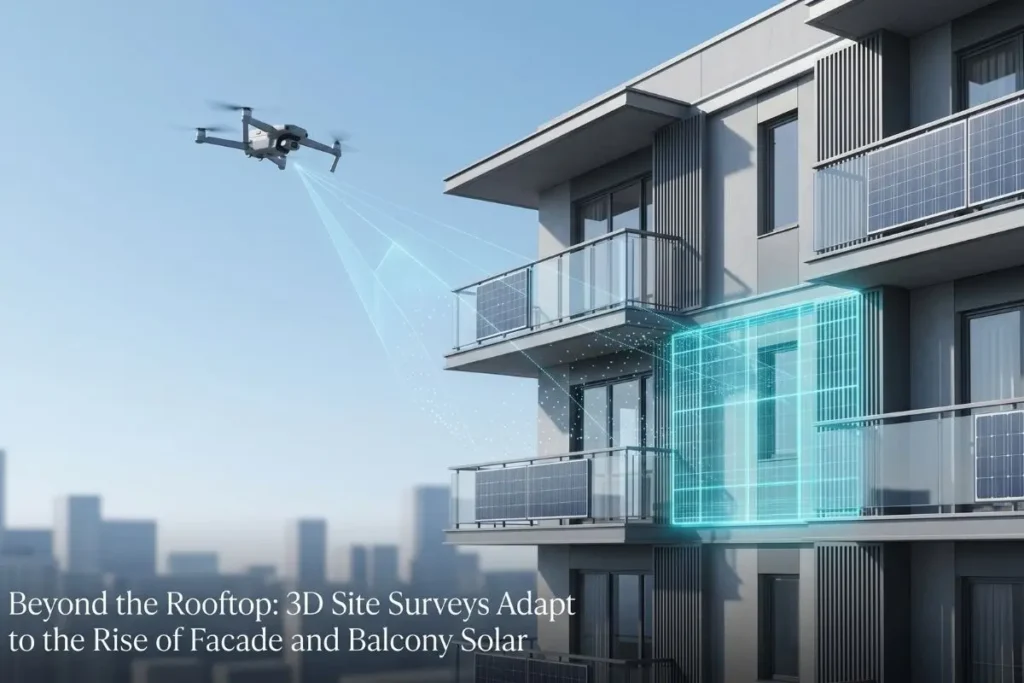
Traditional drone survey workflows capture rooftops from directly above. For facade and vertical surface modelling, the approach needs to incorporate oblique imagery, capturing the building from multiple angles to reconstruct wall surfaces, balcony structures, and ground-level mounting points.
Render-a’s 3D facade survey capability is designed for exactly this use case. By processing drone imagery taken from various heights and angles around a building, the platform generates a precise 3D model of the entire building envelope, not just the roof. This allows solar designers to assess facade areas, balcony dimensions, wall orientations, and potential shading obstructions from neighbouring structures, all from a single drone flight.
For compact solar planning specifically, this workflow enables several things that a rooftop-only survey cannot.
Accurate vertical irradiance modelling. With a full 3D model of the building and its surroundings, shading analysis can be performed on vertical surfaces with the same precision as on rooftops. This means yield estimates for fence-mounted, wall-mounted, and balcony-rail systems are based on real site data rather than generic assumptions.
Multi-surface assessment in a single visit. A residential block may have rooftop potential on the top floor, balcony potential on mid-floor flats, and fence or wall potential at ground level. A comprehensive 3D model captures all of these surfaces in one survey, allowing the designer to propose the optimal solution for each dwelling without returning to site.
Integration with PV planning tools. The 3D models produced by Render-a are compatible with industry-standard tools like PV*SOL and PVsyst. Designers can import the model, configure panel layouts on vertical or tilted surfaces, and run yield simulations with accurate shading data from the real site environment.
Real-world application: compact solar on UK housing stock
UK-based companies are already installing compact solar systems on the kinds of surfaces that require this expanded survey approach.
Thunder Energy, a London-based solar company, has been installing compact solar kits on balconies, garden fences, and walls across Greater London. Their Storm kits use lightweight flexible panels weighing just 3.5 kg each, mounted on surfaces that conventional rigid panels would be too heavy for. Thunder has completed installations on multi-flat residential blocks where each dwelling required a different mounting solution: some on shared roof space, others on individual balcony railings, and others on garden boundary fences. This kind of mixed-surface project is exactly where a full 3D building model adds value, enabling the designer to plan all installations from a single digital twin rather than conducting separate manual surveys for each flat.
As the UK plug-in solar market scales, the volume of these compact installations will grow significantly. Solar companies that can survey, design, and quote for facade and vertical installations efficiently will have a clear advantage over those still limited to rooftop-only workflows.
What this means for solar survey professionals
The rise of compact and plug-in solar does not replace rooftop installations. It adds a new layer to the market. For survey professionals, this means expanding the scope of what a site survey covers to include vertical surfaces, balcony structures, and ground-level mounting points.
The good news is that the technology to do this already exists. Drone-based 3D modelling platforms like Render-a can capture entire building envelopes, not just rooftops, and produce models detailed enough for accurate PV design on any surface. The workflow adjustment is relatively small: additional oblique passes during the drone flight, and configuration of PV planning tools for non-roof orientations.
For solar businesses looking to serve the growing compact solar market in the UK and across Europe, integrating facade and vertical surface surveys into your standard workflow is not a future consideration. It is a competitive advantage available right now.
Learn more about Render-a’s 3D facade survey capabilities or book a meeting to discuss how drone-based modelling can support your compact solar projects.